RUMBAUGH, Charles
Charles Francis Rumbaugh
Classification: Homicide
Characteristics: Juvenile (17) - Jewelry store robbery
Number of victims: 1
Date of murder: April 4, 1975
Date of birth: June 23, 1957
Victim profile: Michael Fiorillo, 58
Method of murder: Shooting
Location: Potter County, Texas, USA
Status: Executed by lethal injection in Texas on September 11, 1985
Final Words:
D.J., Laurie, Dr. Wheat, about all I can say is goodbye, and for all the rest of you, although you don’t forgive me for my transgressions, I forgive yours against me. I am ready to begin my journey and that’s all I have to say.
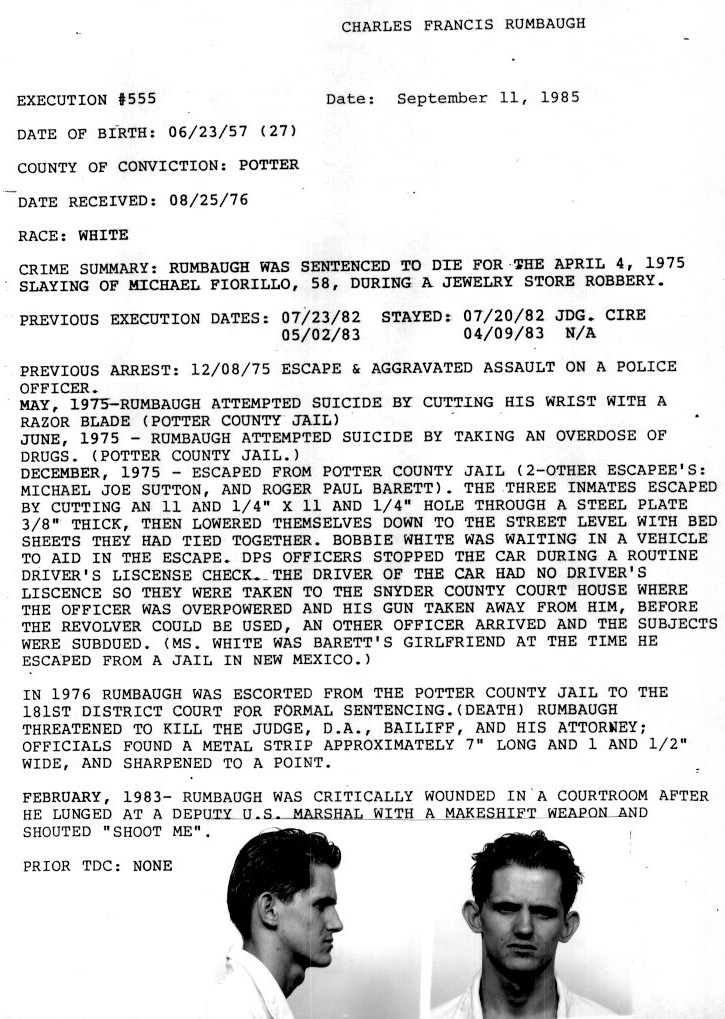
Charles Rumbaugh [white, Texas] was a 17-year-old at the time of a murder carried out during a robbery. He started criminal activity at the age of six and at 12 had committed an armed robbery. When he was executed by lethal injection on 11 September 1985, 10 years after his conviction, he was the first juvenile offender for 21 years to be executed in the USA.
Appeals
Amicus Curiae brief
730 F.2d 291
Harvey and Rebecca RUMBAUGH, Individually, and as Next
Friends acting on Behalf of Charles RUMBAUGH,
Petitioners-Appellants,
v.
Dan V. McKASKLE, Acting Director, Texas Department of
Corrections, Defendant-Appellee.
No. 83-1161.
United States Court of Appeals,
Fifth Circuit.
April 20, 1984.
Appeal from the United States District Court for the Northern District of Texas.
Before CLARK, Chief Judge, GOLDBERG and POLITZ, Circuit Judges.
POLITZ, Circuit Judge:
Presently pending before this court is the appeal of Harvey and Rebecca Rumbaugh from the decision of the district court, Rumbaugh v. Estelle, 558 F.Supp. 651 (N.D.Tex.1983), which denied their application to present a next friend petition for a writ of habeas corpus on behalf of their son, Charles Rumbaugh, a death-sentenced state prisoner.
Charles Rumbaugh refused to seek federal habeas review of his conviction and sentence and he has resisted the efforts of his parents to act on his behalf. Harvey and Rebecca Rumbaugh contend that their son lacks the mental competence to waive his legal rights, and they maintain that he lacks the competence to decide whether to pursue or waive the benefits of 28 U.S.C. Sec. 2254.
The Background
The trial court committed Charles Rumbaugh to the federal prison in Springfield, Missouri, under the authority of 18 U.S.C. Secs. 4241-45, "to determine whether [he] has the capacity to appreciate his position and make a rational choice with respect to continuing or abandoning further litigation or on the other hand, whether he is suffering from a mental disease, disorder, or defect which may substantially affect his capacity in the premises."
After the examination the district court held a hearing and received conflicting expert testimony. The court continued the hearing and directed that the psychiatrist from the Springfield facility be summoned to testify in person to expand and explain his written reports.
At the conclusion of the hearing, dramatically highlighted by Charles Rumbaugh's effort to force the United States Marshal to shoot him to death in the courtroom, the district judge found "that Charles Rumbaugh has a realistic understanding of his present position and of the choices available to him, and that he is mentally competent to make a rational choice with respect to continuing or abandoning further litigation."
Having reached that conclusion, the district court held that Harvey and Rebecca Rumbaugh lacked standing to pursue habeas relief for Charles Rumbaugh. The district court accordingly dismissed their petition and issued a certificate of probable cause for appeal.
On appeal, the essential contention of the petitioners is that because of his mental condition their son cannot make a rational choice to continue or abandon legal proceedings. The gravamen of the medical opinion in support of petitioners' position is that Charles Rumbaugh is not able to countenance the delay inherent in the continuation of legal proceedings and the possible conversion of his death sentence to life imprisonment. It is suggested that he does not have the mental capability to elect to continue further judicial examination of his conviction. That is the issue on appeal.
The court is now informed that Charles Rumbaugh has filed a pro se Application for Writ of Habeas Corpus in the state district court in Potter County, Texas. Upon filing this application, Charles Rumbaugh asked the state district judge to inform this court of his action. At the threshold we must consider the effect of that application on the pending appeal.
The Order
The unusual circumstances of this case require that we fashion a special order, using the authority granted by 28 U.S.C. Sec. 2106.1 We are cognizant that the Texas courts will decline to address a petition for writ of habeas corpus when the petitioner has a writ application pending in federal court. Ex Parte McNeil, 588 S.W.2d 592, 593 (Tex.Cr.App.1979); Ex Parte Green, 548 S.W.2d 914 (Tex.Cr.App.1977). Charles Rumbaugh has no pending federal application. The question before us is whether we should permit his parents to act in his stead and present such an application to the district court. To date he has vigorously resisted those efforts.
If Charles Rumbaugh is incompetent to waive his right to federal habeas review, his parents have standing to evoke a next friend proceeding. Gilmore v. Utah, 429 U.S. 1012, 97 S.Ct. 436, 50 L.Ed.2d 632 (1976) (Burger, C.J., concurring), citing Rosenberg v. United States, 346 U.S. 273, 73 S.Ct. 1152, 97 L.Ed. 1607 (1953); Hays v. Murphy, 663 F.2d 1004 (10th Cir.1981); Weber v. Garza, 570 F.2d 511 (5th Cir.1978). See also Lenhard v. Wolf, 444 U.S. 1301, 100 S.Ct. 241, 62 L.Ed.2d 11 (1979) (in-chambers opinion of Rehnquist, J.); Evans v. Bennett, 440 U.S. 1301, 99 S.Ct. 1481, 59 L.Ed.2d 756 (1979) (in-chambers opinion of Rehnquist, J.).
The recently filed pro se application of Charles Rumbaugh dramatically impacts on the issue before us, specifically, whether he has competence to make a rational choice to either pursue or abandon further judicial review. The state filing mandates a deferral of our decision.
To date the processing of the application of Harvey and Rebecca Rumbaugh has been time-consuming, costly, and exacting. The interests of judicial economy dictate that we avoid any unnecessary repetition of that which has been done previously, at both the trial and appellate level. To that end, we remand this case to the United States District Court for the Northern District of Texas with instructions to monitor the progress of the state habeas corpus proceedings initiated by Charles Rumbaugh. All counsel in this case are directed to keep the district court fully informed of the progress of that suit.
The district court is to advise this court of the final disposition of Rumbaugh's state habeas petition. Should any act or omission by Charles Rumbaugh result in a conclusion of that state habeas suit without an adjudication on the merits, the district court is instructed to return the record to this court for further disposition by this panel. Should that occur, no further notice of appeal will be required and no further filings or briefings will be necessary unless directed by this court. And in that event, this panel will address and promptly resolve the issue posed by the appeal of Harvey and Rebecca Rumbaugh.
Specially REMANDED with instructions.
1
28 U.S.C. Sec. 2106 provides:
The Supreme Court or any other court of appellate jurisdiction may affirm, modify, vacate, set aside or reverse any judgment, decree, or order of a court lawfully brought before it for review, and may remand the cause and direct the entry of such appropriate judgment, decree, or order, or require such further proceedings to be had as may be just under the circumstances.
In the Media
"Not in My Name"
When he was 6, Charles Francis Rumbaugh and an older brother skipped school and broke into an old building in their hometown of San Angelo. At age 12, he pulled his first robbery.
At 17, he killed an Amarillo jeweler struggling for a gun the victim pulled to try and thwart his early morning robbery attempt.
"I was an accident waiting to happen," said Rumbaugh, who worked as a shoeshine boy in nightclubs and bars to help his financially strapped family. He was one of 10 children born to a truck driver.
Rumbaugh, who had admitted dozens of heists in Texas and Arkansas, said he had spent the last 15 years of his life, except for an eight month spell of freedom, either behind bars or in a mental hospital.
In that first holdup at age 12, he used a tire tool to rob a gas station and made his getaway on a stolen bicycle. "I just gravitated to armed robbery," he said.
After being declared a juvenile delinquent, he spent four years incarcerated at the Texas Youth Commission facilities at Gatesville and Mountain View.
The juvenile institutions hardened his spirit and set the pattern for the rest of his life, said his brother, Rex Rumbaugh of San Angelo.
"Being in those schools took his youth away," Rex Rumbaugh said. "He never really had a chance in those schools."
"He shouldn't have been put in Gatesville (juvenile center) in the first place. He was first sent there for skipping school, and it was after that he got into auto theft and those things."
The teen-aged Rumbaugh was on his way to Los Angeles, fleeing a shoot-out with police at the Downtowner motel in San Angelo when he stopped in Amarillo to visit his sister and pulled his last robbery, a crime that ended in murder and sent him to the Texas Death House.
He decided he needed cash to repair his stolen car and wanted to "pull a few more jobs" before heading to the West Coast.
Armed with a .25-caliber automatic, Rumbaugh entered the jewelry store on West 10th Street. During the robbery, owner Michael Fiorillo, lunged for a hidden gun and a struggle ensued.
"He went for it," Rumbaugh recalled. "I could've shot him in the back right there, but I didn't think it was necessary. We got to struggling, and I shot him."
Rumbaugh, who twice attempted suicide while awaiting trial, recently talked about Fiorillo's death. He didn't deny that he was responsible, and he said he was haunted by the man's cries for help.
"He probably laid there for about 40 minutes and eventually drowned in his own blood," said Rumbaugh. "I'd like to think that, since I've been shot, I've gone through a lot of the same suffering that he went through."
Rumbaugh was shot during a February 1983 mental competency hearing, when, using a make-shift knife, he yelled "Shoot me!" and attacked a U.S. marshal. He was wounded in the left arm and chest.
His parents had sought the mental competency hearing after Rumbaugh tried to stop appeals. At the time he said he had chosen his executioner and wanted to be shot to death then.
The wounds bothered him during his last years on death row, but Rumbaugh never tried to have his conviction overturned.
Rumbaugh lived for nine years on death row. He told friends who visited him before his execution he was ready to die.
"About all I can say is goodbye," Rumbaugh said as he lay strapped to the death chamber gurney with needles inserted into his arms. "For the rest of you, even though you don't forgive me for my transgressions, I forgive you for yours against me. That's all I wish to say. I'm ready to begin my journey," Rumbaugh said, seconds before the lethal drugs flowed into his veins. He was pronounced dead 10 minutes later.
Rumbaugh arranged for his body to be cremated and the remains placed in a miniature coffin he made himself of matchsticks lined with blue velvet and a red bandana.