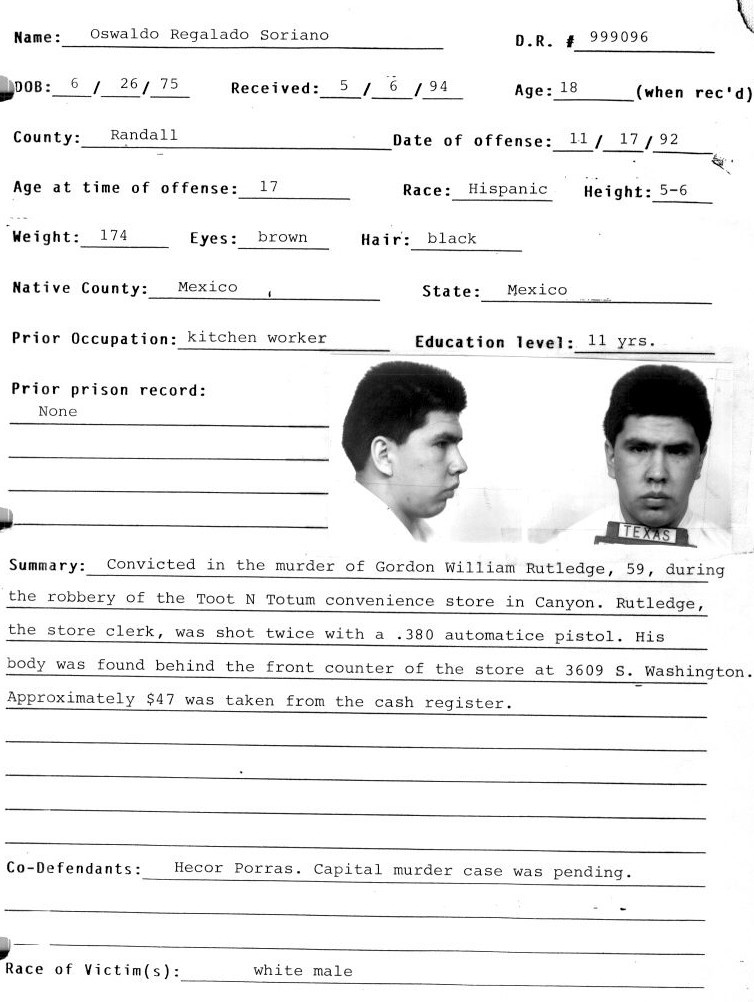
SORIANO, Oswaldo
Oswaldo Regalado SORIANO
| Offender | information |
|---|---|
| Classification | Homicide |
| Characteristics | Juvenile (17) - Robbery |
| Number of victims | 1 |
| Date of murder: | November 17, 1992 |
| Date of birth: | June 26, 1975 |
| Victim profile: | Gordon William Rutledge, 59 (store clerk) |
| Method of murder: | Shooting |
| Location: | Randall County, Texas, USA |
| Status: | Sentenced to death on May 6, 1994. Commuted to life in prison in 2005 [1] |
Letter to the Public
Feb-8- 2000
My name is Oswaldo (Soriano) Regaldo, #999096 I am a Death Row Inmate here on the Terrell Unit.
I am in great hopes that perhaps you and your establishment are able to help me in gaining world-wide attention, of the injustice being imposed to me and my case, by being placed on the inter-net and perhaps fixing me up a web site.
Before I go any further let me express my gratitude to all of you in general, for the courage you put forth in helping us Death Row inmates despite the tremendous odds. Know that I am extremely grateful for your time and for any support that you are able to help me with.
Let me tell you a little of myself and case history. My name, (you already know); I'm Mexican/Bilingual, I am 24 years old, born :June 26, 1975. Was born in the city of Chihuahia, Mexico.
I arrived on Death Row, May 6, 1994.
I like to pass my time drawing, writing some poetry, and reading anything of history, mostly all that can give some type of wisdom and knowlegde. My main struggle is trying to learn and study the law, but due to the isolation, I am very limited in learning since there is no physical contact between one another, (as back on the other Unit ,Ellis). Here it is total isolation and we live in an "lce Box!" the cold air is never turned off, so we are kept in a coma of some sort due to coldness. I mostly like to keep myself in shape by doing all types of exercises, I used to play basketball and handball, but there is no room for that here, since one recreates by oneself. Due to this isolation, I've managed to maintain my sanity and keep my spirits up.
About my case; The alleged murder was committed on November 17, 1992,
I had just turned 17 years old. I was found guilty of capital murder:May 4, 1994 and given a death sentence on the May 5, 1994, (the very next day).
This alleged murder took place in a store, in Amarillo, Texas, the victim was shot with a 380 caliber pistol. Being that I was a juvenile at the time of this crime and on juvenile probation, Instead of being automatically picked up and charged with capital murder, I was listed on All-points-bulletin, (with the police department) as a runaway. Which was true. Me and three other juveniles lived at a home to ourselves. All of us were arrested as runways, out of all of us I was charged with capital murder 7 hours later, even though I had nothing to do with this murder, but guilty of being just a runaway. As you can see the county held me till I was 19 and half years of age before even taking me in front of a jury trial. All this is documented in trial records. I recently went back on a hearing on my case, due to the lack of evidence the state presented to the courts. So, as we speak, my case is still on direct appeal, awaiting the judges response to all the new evidence.
What I so greatly wish is, to find people, women, men of any age that can perhaps assist me in any possible way, whether it be moral support, advice, legal advice and simply just to be a friend and helping me see the outside world. I have never really experienced much of the outside world nor it's beauty. I'd be so appreciative of any response whether you are for or against the death penaly. I will answer all letters. I look forward to hearing from any of you.
Thank you for your time, and attention on this matter.
Please send all letters to the address listed below.
Respectfully,
Oswaldo Soriano Regaldo
#999096 Death Row
Polunsky Unit
12002 F.M 350 South
Livingston, Texas 77351[2]
Soriano in the media
The Darkest Hour:
Stories and Interviews from Death Row, Chapter One
Posted on: November 4th, 2012
No Tears, Only Silence
Oswaldo Soriano
“I was born in 1975,” Oswaldo said as I picked up my pen and began to write about his early life. Oswaldo was born in Mexico but has no memory of what it was like to live there. When he was three years old, his mother and one of his brothers came to the United States in search of a better life. Oswaldo and his family made a home in Pama, Texas, also known as the “Texas Panhandle,” where there was a unique mixture of city life and country atmosphere. Oswaldo lived a relatively normal life. His mother eventually married, giving him the father he never had and a husband for her to provide for the family. Oswaldo never knew his biological father; he left before Oswaldo was born, perhaps never knowing of the birth of his son. When his mother married, Oswaldo was happy to have someone to call Father. Life got better for a while, but the good times did not last very long.
When his stepfather lost his job, Oswaldo suddenly found their relationship turning sour. His stepfather, as a way to relieve his frustrations, began to use Oswaldo as a punching bag. When his mother protested, the beatings became more frequent and more intense. As time went on, his mother began to pay scant attention to Oswaldo or the beatings Oswaldo suffered. By the time Oswaldo was ten years old, he had become a tough little kid who suffered abuse without shedding a tear. As Oswaldo described the beatings, his voice became flat and void of all emotion. “If I did cry or my mom cried, I would get hit harder. It got to the point where I conditioned myself to feel nothing at all.”
By the time Oswaldo was eleven years old, his schoolwork was suffering. He got into fights and was eventually transferred to another school for his behavioral problems. As he entered fifth grade, he noticed that he was one of the few Mexicans in a predominantly black school. His schoolmates did not accept him and trouble came in bundles. Soon school became a battleground for Oswaldo, and he began to hate going to school. One day a few kids jumped him and beat him badly, causing the teacher to notice his bruises. When questioned, he kept silent. He was sent to the principal’s office and still kept silent. He would not tell on the kids who beat him, so his parents were called in. Oswaldo’s stepfather, fearing that Oswaldo told the principal of the home beatings and that the bruises were from him, came to school outraged. When they got home, without fail, the beating began again. Oswaldo closed his eyes and ignored the pain from the lashes. He felt nothing.
A few weeks later, a black kid named Lamar thanked Oswaldo for not snitching on him and the others. They became best friends. As an act of friendship, Lamar gave Oswaldo a pit bull puppy. Oswaldo was allowed to keep the dog since his stepfather liked pit bulls too. Oswaldo promised he would care for the dog and keep it away from the chickens that roamed the backyard. Oswaldo named the dog Pancho. Sometimes Pancho gave Oswaldo more trouble than he was worth by chasing his stepfather’s chickens, inciting his stepfather’s anger.
Early one morning as Oswaldo was getting ready for school, he heard his stepfather calling him to the backyard. He marched there smiling. “What’s up, Papa?” As he looked around, he saw that Pancho killed a few chickens. He recalls staring into his stepfather’s twisted enraged face. “It felt like a snake bit me in the leg when he hit me with the water hose. I stood there like a warrior trying to take the beating, but the hose was tearing my skin. I heard my mom screaming as I saw the blood rush from my wounds. For the first time in a long time I started to scream and cry. When another blow hit me in the neck, I reached up in rage and snatched the hose from Papa. Soon after this incident I left home.” Oswaldo had no choice but to leave his beloved dog behind.
Reported to the police as a runaway, Oswaldo stayed at Lamar’s house for a few weeks and later found refuge on the streets of Amarillo with a gang called Vario 13. Due to his young age, the gang members gave him the name Junior. From that point forward, Oswaldo took the name Junior, leaving his birth name in the backyard with the blood-soaked hose and abandoned puppy.
Crack cocaine flooded the streets of urban America in the 1980s, and gangs had been recruited to distribute and help control this lucrative drug trade. Junior joined the ranks and started running the streets. In its early years, Vario 13 was just another bunch of kids who were sought to distribute drugs. So at twelve years old, Junior got involved in drug distribution. Junior was like a young pup in a den of wild dogs. By the time he was fifteen years old, he had been in and out of the state’s juvenile reformatories. The reformatories were a second home to him.
While Junior was in these institutions, he was described by juvenile authorities and probation officers as a “child in need of supervision … a follower.” The resident psychiatrist said that most children who were like Junior were regarded as a hero when they are morally impoverished, have no remorse and are expected to lead other juveniles in the segregated institutions.
Subsequently, Junior unconsciously destroyed the boy within him and took the role of “wolf” in the eyes of the neighbors who knew him. Like the tale of so many other abandoned and abused children, they clung to others with whom they could self-identify. Though his counselors did notice, despite his illiteracy, that he had great artistic talent, nothing changed for Junior in the state reformatories. When spoken to about his talent, Junior became defensive. He had become unfeeling so as to ignore all the pain of those beatings and became apathetic to any feeling whatsoever. Emotional preservation required that he close himself off from feeling anything. No one is born good or evil. They become a reflection of the people around them and a product of their childhood experiences. Sadly, Junior was never embraced nor did he ever feel loved.
On November 18, 1992, Junior was arrested again, this time the charge was very serious—capital murder. A robbery took place and many people’s lives were changed forever. One of those lives was taken and another one thrown away. Oswaldo was judged as a threat to society, and he was sentenced to death at the age of seventeen. Almost as though he were two people, he found a safety net in being Junior, the unfeeling kid turned street hustler whose life was judged meaningless.
Life as a gangster taught Oswaldo many things: primarily, a sick and twisted sense of loyalty and honor that forbade him from snitching on those who were involved in the crime for which he was sentenced. Unfortunately, no one probably knows that Junior exists except the other convicts who will further try to contain and shape this explosive man full of pain. His potential to become anything he wants to be is unspeakable because his ability to learn so quickly keeps his peers in awe and silences them. I use the term unspeakable because Junior is, in reality, still a boy. Erasing his existence seems the easiest thing for the state to do. They have a conviction, so who cares? No one? While juvenile officers and prison guards mentally rape and destroy the minds of young kids such as Junior, the invisible part of him—the boy named Oswaldo—remains tucked away, looking for the chance to have a normal life. Junior has never cried wolf. He has never said anything at all.[3]
{{include Script:section_collapse}}